Don’t create tomorrows complexity with yesterday’s methods

Complexity can be an asset when used intentionally. We combine process and data analysis, digitalisation and software development to simplify operations and make products more attractive.

Your Challenge: Complexity

When asked about the biggest challenges in your company, you might not immediately say “complexity.” Instead, you probably recognize several of the following symptoms:

If you are a manager in a corporation or mid-sized company and find yourself nodding at several of these points, it might be time for us to talk.

What we do: Services

We simplify complex processes, make them "digital-ready" and, if requested, implement them in software. We build a technical view of product and process landscapes, apply data analytics to create transparency, identify optimisation points, prototype solutions and support complete implementation, including managing external IT vendors.

Visionsberatung for Self-Study

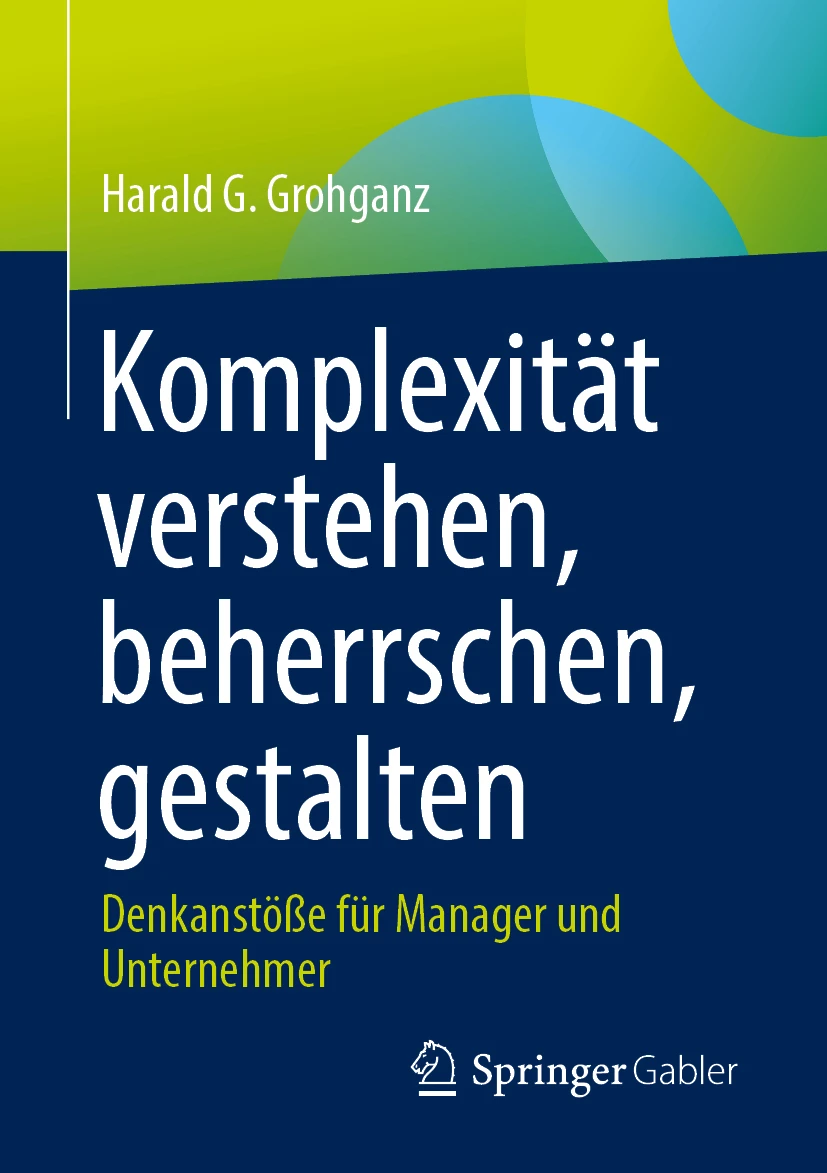
Buchcover »Komplexität verstehen, beherrschen, gestalten« ISBN 9783662699102

Complexity is one of the defining challenges of our time. Companies struggle with uncontrolled growth in their product portfolios; new requirements lead to sprawling, inefficient processes. Established structures try to protect their advantages but often block innovation. On a broader social level, the flood of information creates avoidance behavior and polarisation — once differing opinions become seemingly unbridgeable divides.

Understand complexity. Manage it. Design solutions.

This book introduces complexity in its many forms and effects, combining theory with real-world business and everyday examples. First comes the theory: What types of complexity exist? Why does complexity create problems? Why is it sometimes built intentionally, and how can it be reduced? Reflection questions invite readers to analyze their own situation. Then comes the practice: the author presents real cases from companies and society, examines the context, and explores possible solutions.

More information and the practical case studies can be found on the book’s website.

Note: The book and its website are currently available only in German!

Use case: Data analytics is complexity reduction

An exemplary data analysis pipeline

The sketch below shows a simplified flow for a typical data analysis project. On the left are your source systems (often optimised for transactional tasks, not analysis). On the right is the dashboard you want.

Source systems Local database Analytic datasets Dashboard
source db local datasets dashboard
TB hours GB seconds MB instantly KB

Large databases are rarely fast for ad-hoc analysis: terabytes of data are unnecessary for most use cases. Effective dashboards are usually based on sensible data slices (selections) and aggregations. The trick is to precompute these slices for many use cases — e.g. overnight — and cache them in local databases or in-memory structures. From there, analyses can be produced in seconds (for example using Python and pandas) and fed into visual dashboards.

Example solutions

Open-source visualisations for d3

We publish several example visualisations as open source code. These include interactive map visualisations (by postal region), a treemap for hierarchical data, and filterable bar and pie charts. Some of these visualisations are used at the Statistikportal of German Health Data Lab.

website srv.visbe.de/mapvis
Screenshot of srv.visbe.de/mapvis (dark mode)

The examples provide JavaScript, CSS and a minimal page structure to help you implement similar visualisations on your data.

Variant trees in self-service

Tabular data often contains hierarchical relationships. A variant tree reveals hidden dependencies and helps understanding. We published a lightweight webapp that runs entirely in the browser: upload a CSV locally and explore tree views, aggregate or expand individual columns and download the resulting SVG.

website srv.visbe.de/treevis data table
Screenshot of srv.visbe.de/treevis (light mode)

From Vision to Implementation in Three Steps

Our structured framework provides clear guidance on how we turn complex challenges into practical solutions.

Create transparency

Create Transparency

Before moving toward implementation, we first establish a clear understanding of your current situation. Together, we identify the factors that may influence your project’s success. Alongside process and data analysis, we rely heavily on the expertise of your in-house specialists.

Depending on your needs, this assessment can be a one-time exercise or the foundation for a reporting system that allows recurring analyses and accelerates future decision-making.

Evaluate scenarios

Evaluate Scenarios

There is rarely just one way to achieve your vision. We define and compare multiple scenarios to determine which approach offers the greatest potential. This evaluation often involves digital tools: from simple spreadsheets with defined parameters to specialized algorithms and, where appropriate, self-learning software.

Shape changes

Shape Changes

Once a clear strategy is defined, we focus on implementation while ensuring that changes align with day-to-day operations. Our goal is to make the transition practical and inclusive so that everyone involved can contribute effectively. Digital systems such as reporting and monitoring tools help track progress, while automation reduces errors and repetitive work.